Donors
The Natural History Museum Basel is relocating, moving into a brand-new building and putting down roots in a different part of the city.
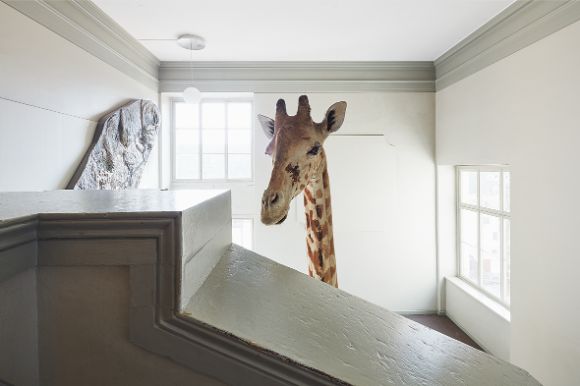
Although this marks a change, the museum will keep the story going, taking with it the very essence of what makes it special. This includes the giraffe which has been a symbol of the museum’s identity and has been closely associated with the Natural History Museum Basel for decades. It is linked to countless stories, memories and emotions.
Be part of it from the very beginning. Help us lay the foundation and become a Founding Donor. As a member of this circle, you will help ensure that our giraffe continues to captivate and inspire visitors in the new museum. The historic exhibit is set to find its new home in the ‘Forum’, the new museum’s central meeting place and education space. Surrounded by displays of the collection’s history and the museum’s development over the past 150 years, the giraffe will be embedded within this narrative, drawing together history, knowledge and identity.
To provide a compelling narrative of the giraffe’s extensive story, we require financial support.
Honouring history – paving the way for the future
Your commitment will allow us to furnish the new museum in St. Johann with a true icon which stands as a symbol of the museum’s history and reflects the care we take in preserving it.
How do I become a founding donor?
As a Founding Donor, you become part of a special circle of supporters. You help ensure that our giraffe will continue to inspire our visitors – from preschoolers and school groups to young adults, families and the older generation – and remind us of the place we humans are meant to occupy and rightfully deserve.
Founding Donors contribute an amount of CHF 5,000.
With this one-time contribution, you are considered a Founding Donor and enjoy the associated benefits.
Following the museum’s reopening in 2029, you will have the opportunity to remain connected to our institution as a member of a permanent Donor Circle. We will be pleased to provide you with further information about these opportunities for engagement at a later date.
Good to know
Financial contributions to the museum are made through the Foundation for the Promotion of the Natural History Museum Basel. According to the applicable legal provisions, you can claim your donation as a tax deduction. We will send you a written certificate for this by February of the following year.
Yes, but in a different way?
Would you like to support the new museum in some other way? We would be happy to talk to you in person about the various ways you can help the new museum become a shining beacon for the city.
Your benefits
As a member of our circle of founding donors, you will enjoy a range of exclusive benefits.
We offer:
- 2026: A tour of the construction site for the new building
- 2027: A guided tour of the completed but still vacant museum
- 2028: A front-row seat during the careful restoration of the giraffe
- 2029: Invitation to a preview of the new museum
- Upon request, a personal mention alongside the respective object, in the museum’s annual report and, where applicable, on the museum website
- Free admission to the exhibitions at the old location in Berribau until it closes in 2028
- Complimentary lifetime admission to the new museum’s permanent exhibitions
A giraffe with cult status
The Maasai giraffe has adorned the stairwell of the Natural History Museum for around 90 years. With generations of visitors having admired this proud animal, it represents countless memories our visitors associate with the Natural History Museum. Along with other large exhibits, it is an integral part of the museum. The giraffe evokes a wide range of emotions and provokes much discussion.
The giraffe embodies the history of the museum
In 1934, the Basel industrialist René Clavel travelled to Tanzania. On a big game hunt, he killed the Maasai giraffe and donated it to the museum upon his return.
The Maasai giraffe is the largest subspecies of giraffe and the tallest land animal on Earth. With its impressive height of up to six metres and its powerful heart, it is perfectly adapted to life on the African savannah.
Each individual has a distinctive, jagged pattern of spots. This striking feature makes the giraffe one of the most popular wild animals worldwide.
However, the species is critically endangered. Habitat loss, human interference in its habitat and poaching have drastically reduced its population. Protecting the giraffes also means preserving the African savannahs and their biodiversity.
Historical specimen
The dermoplastic specimen was produced in 1934 by Adolf Haug in Stuttgart, a leading taxidermist of the pioneering era surrounding and following the legendary Hermann ter Meer. The giraffe is striking for its size and the taxidermy work, which was carried out with the utmost care according to the state of the art in taxidermy prior to the Second World War. In the 1980s, it underwent surface restoration and was coloured with hair dye.
The condition of the specimen, particularly the skin and the anatomical structure, no longer meets today’s standards. Nevertheless, serving as a representative example of a particular era in collection history, it is of great historical significance and must be understood within its historical context.
European collectors were still going on expeditions to hunt animals at the beginning of the 20th century, a time when colonial power dynamics played a significant role. Today, the museum offers a critical assessment of this era and provides transparent information about it.
The giraffe’s new home
As an important historical artefact, the giraffe will be given a prominent place in the new museum. It will be displayed in the Forum, a central, open and multifunctional space designed to be the heart of the building. This is where the museum’s history will be explored, covering both the chronology of the collection and the museum’s history spanning some 200 years. The encounter between past and present also raises questions about the role the museum should play in the future.
Matthias_Willi.jpg)